
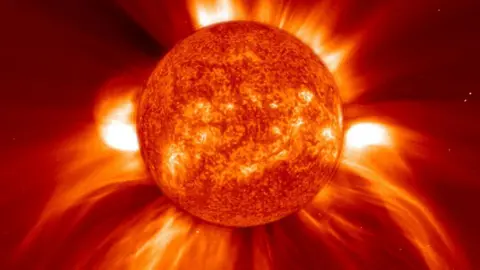
Regarding India's first solar observatory, 2026 is expected to be truly unique.
It's the first time the spacecraft – which was placed in orbit recently – will be able to watch our star when it reaches the peak of its solar cycle.
As per research, it comes roughly once every 11 years as the Sun's magnetic poles flip – a similar Earth scenario would be the North and South poles swapping positions.
It's a time marked by intense activity. It involves the Sun changing from calm to stormy and features a significant rise in the number of solar eruptions and coronal mass ejections (CMEs) – enormous clouds of fire that blow out from the solar corona.
Made up of ionized particles, a coronal mass ejection may have a mass of billions of tons and can attain a speed of up to 3,000km per second. It can head out toward various directions, including towards the Earth. At maximum velocity, it would take an ejection about half a day to cover the 150 million km between Earth and the Sun.
"In the normal or quiet periods, our star emits two to three CMEs a day," says a leading scientist. "Next year, we expect them to be over ten each day."
Researching CMEs is one of the most important scientific objectives for the Indian maiden solar mission. Firstly, as these eruptions provide an opportunity to learn about the star at the centre of our solar system, and secondly, since events occurring on the Sun endanger infrastructure on Earth and in space.

Impacts on Earth and Orbital Systems
CMEs seldom present immediate danger to people, yet they impact our planet by causing magnetic disturbances affecting the weather in near space, where nearly thousands of spacecraft, including Indian satellites, are stationed.
"The most beautiful displays from solar eruptions include northern lights, being direct evidence that solar particles from Sun journey to Earth," the expert clarifies.
"However, they may make all the electronics aboard spacecraft fail, disable power grids and affect weather and communication satellites."
Past Solar Incidents
- The most powerful solar event in history was the Carrington Event that disabled communication systems worldwide
- In 1989, a part of Canadian electrical network failed, affecting six million people without power for nine hours
- In November 2015, solar storms disrupted air traffic control, leading to disruption across Scandinavia and some other European airports
- In February 2022, a CME had led to dozens of spacecraft failing
If we are able to observe events in the solar atmosphere and detect a solar storm or solar eruption as it happens, record its temperature at the source and watch its trajectory, it can work as advanced warning to switch off power grids and spacecraft and move them to safety.
Aditya-L1's Unique Advantage
While other solar missions observing the Sun, India's spacecraft holds an edge compared to rivals when it comes to studying the solar atmosphere.
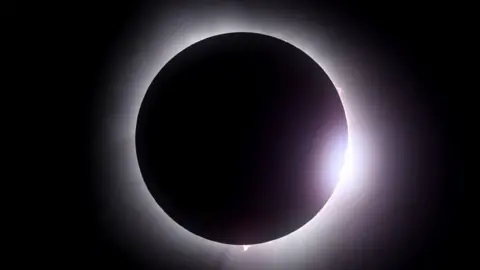
"The instrument has perfect dimensions enabling it to nearly mimic the Moon, completely blocking the Sun's photosphere and allowing it continuous observation of almost all solar atmosphere 24 hours a day, 365 days a year, even during eclipses and occultations," notes the expert.
Essentially, the coronagraph acts like an artificial Moon, blocking the solar glare allowing scientists constantly study the dim solar atmosphere – something the real Moon provide only during eclipses.
Moreover, this is the only mission that can study solar events in visible light, enabling it to determine a CME's temperature and heat energy – key clues indicating the intensity a CME would be if it headed our direction.
Preparation for Maximum Activity
In preparation for the upcoming solar maximum, researchers collaborated analyzing information gathered from one of the largest CMEs that Aditya-L1 has recorded until now.
It originated on 13 September 2024 during early hours. The eruption's weight totaled billions of tons – the iceberg that struck the ship was 1.5 million tonnes.
Initially, the heat was 1.8 million degrees Celsius with energy equivalent was equivalent to millions of tons of TNT – relative to the atomic bombs used in Japan were 15 kilotons and 21 kilotons respectively.
Although the numbers make it sound massive, the scientist classifies it as a "medium-sized" one.
The asteroid that eliminated the dinosaurs on Earth was 100 million megatons and during solar peak occurs, we could see eruptions with energy content matching even more than that.
"In my view the CME we evaluated happened during periods was in the normal activity phase. Now this sets the standard for future comparison assessing what is in store when the maximum activity cycle occurs," he says.
"The insights from this will assist in work out protective measures to be adopted safeguarding satellites in orbit. They will also help achieving deeper knowledge of our space environment," he concludes.


