
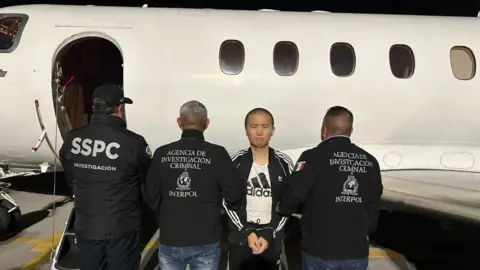
 Secretary of Mexico's Security and Citizen Protection
Through a evening announcement this past Thursday, the Cuban Government stated that they handed over a Chinese citizen, Zhang Zhi Dong, to the authorities in Mexico. Hours later, the nation's top security officer verified his later transfer to the United States on drug trafficking and money laundering charges.
This concluded a lengthy, audacious escape attempt from a globally sought criminal.
Known by various aliases such as Brother Wang, Pancho, or HeHe, Zhi Dong Zhang is accused by the US Justice Department for orchestrating a vast international ring involved in fentanyl distribution and illicit finance spanning multiple countries but particularly China, Mexico and the US.
Zhang faces an extensive indictment yet fundamentally American and Mexican legal authorities allege his significant role within international narcotics trafficking. They say he has laundered millions of dollars in drug money on behalf of the Sinaloa and Jalisco cartels within a global narcotics supply chain.
"This individual can be seen as an essential connection linking Mexican drug syndicates and Chinese chemical companies in sourcing the pre-cursor chemicals for fentanyl", explains former DEA agent, Mike Vigil, adding that he was also vital in converting drug funds into cryptocurrency.
Upon being found guilty, Zhang Zhi Dong can expect to share a similar fate like other narcotics lords such as 'El Chapo' Guzman or 'El Mayo' Zambada in a high-security facility on US soil.
But how 'Brother Wang' ended up in custody in Havana is an extraordinary tale featuring an escape from home confinement in Mexico City, reportedly through a hole in a wall, boarding a private aircraft to Cuba and an ultimately failed attempt to enter to Russia.
Zhang's initial arrest occurred within the Mexican capital in a joint security operation in October 2024. He was initially held in a maximum-security prison but subsequently received home confinement by a judge – a ruling President Claudia Sheinbaum labeled "shocking".
His breakout had all the hallmarks of yet another humiliating incident for Mexican authorities: a man considered a vital cog in the machinery of drug smuggling, managing to vanish despite Mexican official surveillance tasked with guarding him. El Chapo accomplished this twice, much to Washington's frustration, before he was finally put on a plane in handcuffs to the US.
That Mexican authorities were able to recover their prisoner coupled with his northern transfer resulted from two factors – an apparent stroke of luck in Russia and robust Mexico-Cuba security ties.
When Zhang reached Cuba in July 2025, he set about making his next steps towards reaching a country with no extradition treaty with the US, according to officials.
There is a direct commercial flight to Moscow from Havana and Zhang, authorities claim, managed to book passage with fraudulent documents. Yet, these documents failed to clear Russian immigration officials. Reports indicate Russian authorities didn't fully recognize who they had in their custody and, following short-term detention, they turned Zhang around and sent him back to Cuba.
On arriving back in Havana a second time, the Cuban security services were now aware regarding his true identification.
Analysts suspect the authorities in Cuba held onto him for several months to interrogate him at length prior to his Mexico repatriation and, ultimately, transfer to the United States. Mexico's security secretary, Omar Harfuch, promptly expressed gratitude to Cuba for their collaboration regarding 'Brother Wang' – ultimately, for sparing their blushes concerning another fleeing notable inmate.
Customarily after a suspected leader's capture, the question becomes what impact their apprehension will have on international narcotics trafficking.
Considering his recent year in incarceration, home confinement, or fugitive status, the question may be moot, Vigil commented, as his absence has already largely been felt in Mexico's criminal underworld:
"There will be minimal effect as the cartels already have individuals working for them who can start to replace to Brother Wang", Vigil states. "Even with El Chapo Guzman who was a much bigger figure, global narcotics flow continued unabated", he contends.
Over his first year in office, US President Donald Trump has urged Mexico's leader to do more on the issue of fentanyl trafficking and President Sheinbaum's administration has duly responded in kind. Her administration has boosted confiscations of the drug relative to the prior administration and has extradited numerous convicted cartel affiliates to the United States for sentencing. They included several high-level drug names such as Rafael Caro Quintero, wanted for the murder of a DEA agent in 1985.
Her cooperation on the fentanyl issue, along with immigration enforcement, is considered the reason Trump has avoided implementing the same level of trade tariffs against Mexico as applied to other trade allies.
Brother Wang's extradition will provide real gratification to US officials for removing a crucial individual from cartel financial activities out of circulation. This, subsequently, will satisfy the Sheinbaum administration in Mexico and strengthen their claim to be in lockstep with their US counterparts on security.
Nonetheless, curbing or diminishing the movement of pre-cursor chemicals for fentanyl from China to the Americas in any sustainable manner requires more than one individual's extradition.


